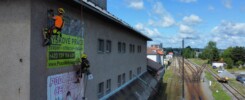
At first glance, they seem alike—compact descenders designed for work at height and rescue operations. The Petzl Rig and the new Singing Rock Jack appear to be contenders in the same weight class. However, thorough testing reveals that the differences are more significant than they first appear.
After a month of real-world use in various conditions, one thing is clear: Jack isn’t just an alternative to the Rig—it’s a well-thought-out, technically refined solution.
Similar at First Glance, Different in Practice
First impressions can be deceiving. Both devices are similar in size and share the same core functions—descent control, rope guidance, and positioning. At a glance, they seem nearly identical. However, the real differences become evident during day-to-day use.
Controls That Make Your Work Easier
Jack offers smoother and more comfortable control—especially noticeable when working on longer ropes. Descent regulation feels precise, without the jerky movements that sometimes occur with the Rig. Overall, Jack’s handling is calmer and more intuitive, which is something every rope access technician will appreciate during extended use.
Smart Details: Magnetic Cam
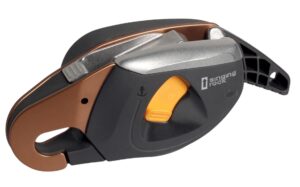
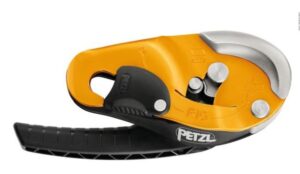
One of Jack’s standout features is its magnetic cam system, which holds the cam open. This makes rope installation fast and intuitive, without needing to operate the control lever. In contrast, the Petzl Rig requires manual lever movement—something that demands more attention, especially when wearing gloves or working under time pressure.
Wider Rope Compatibility
The Singing Rock Jack is compatible with ropes ranging from 9.3 to 12 mm in diameter—offering a wider range than most similar devices on the market. This makes it suitable for various applications, from thinner ropes used in rescue scenarios to thicker lines common in standard rope access work.
This versatility gives users more flexibility when selecting gear and makes the Jack easier to deploy across different environments and job types.
Build Quality and Durability
Both devices are made from high-quality materials and exhibit excellent craftsmanship. The Jack feels robust and precisely engineered, with smooth operation of all moving parts. While long-term durability will only be proven through repeated field use, the initial impression is highly positive.
Singing Rock Jack
PetzL Rig
| Feature | Singing Rock Jack | Petzl Rig |
|---|---|---|
| Weight | 410 g | 400 g |
| Materials | Stainless steel, light alloys, durable plastic | Aluminum, steel |
| Rope diameter | 9.3 – 12 mm | 10 – 11.5 mm |
| Max working load | 200 kg (EN 12841‑C) / 150 kg (EN 341‑2A) | 150 kg personal / 200 kg rescue use |
| Certifications | EN 12841‑C, EN 341‑2A, EN 15151‑1 | EN 341 Type 2A, EN 12841‑C, EN 15151‑1, ANSI, NFPA 2500 etc. |
| Magnetic cam | Yes – simplifies rope installation | No – manual cam opening required |
| Colors | Gold, black | Yellow, black |
| Auto-locking | Yes – activates when control lever is released | Yes – locks automatically when handle is released |
| Functions | Descent, ascent assist, positioning, rescue etc. | Descent, ascent assist, positioning, rescue etc. |
| Wear resistance | Stainless parts, openable for cleaning | Stainless wear surface for longer durability |
| Availability | Autumn 2025 | Already available |
| Estimated price | Expected to be more affordable than Petzl Rig | Approx. 195 EUR (as of 01/2025) |
Summary: A Worthy Competitor and a Thoughtful Alternative
The Singing Rock Jack is more than just another descender—it brings smart innovations that save time, enhance safety, and simplify rope handling in real-world conditions. If you’re looking for a device focused on efficiency and intuitive control, Jack is well worth your attention.
Compared to the time-tested Petzl Rig, Jack offers a fresh perspective and several clear advantages. In day-to-day use, it may just be the surprise upgrade you’ve been waiting for.